
Футбол
Обзоры
10.01.2025
Intro. Barefoot on hot coals.
This introductory article is designed to introduce a wide range of users to the philosophy and main ideas that the VoteSport project embodies, without deep immersion in algorithms and technical components. It is assumed that the reader has basic knowledge and concepts in such areas as betting, stock trading, and blockchain technologies.
Bids? Forecasts? Predictions? TRADE!
What do the US presidential election, a football match, and the price of Bitcoin have in common? These are events that last over time with several alternative outcomes, which can turn into reality with varying degrees of probability.
Now imagine that instead of the usual price of $ per barrel of oil on the stock exchange, there would be a certain coefficient reflecting the % potential profit of an oil trade on the stock exchange, and the probability of Trump's election as US president would be expressed as trading synthetic assets with yes/no outcomes, where the price for them reflects the probability. Nonsense? No. It's just that many people are not used to these abstractions. But in both cases, we are dealing with a balanced market reward/risk ratio for each outcome, expressed in price or coefficient.
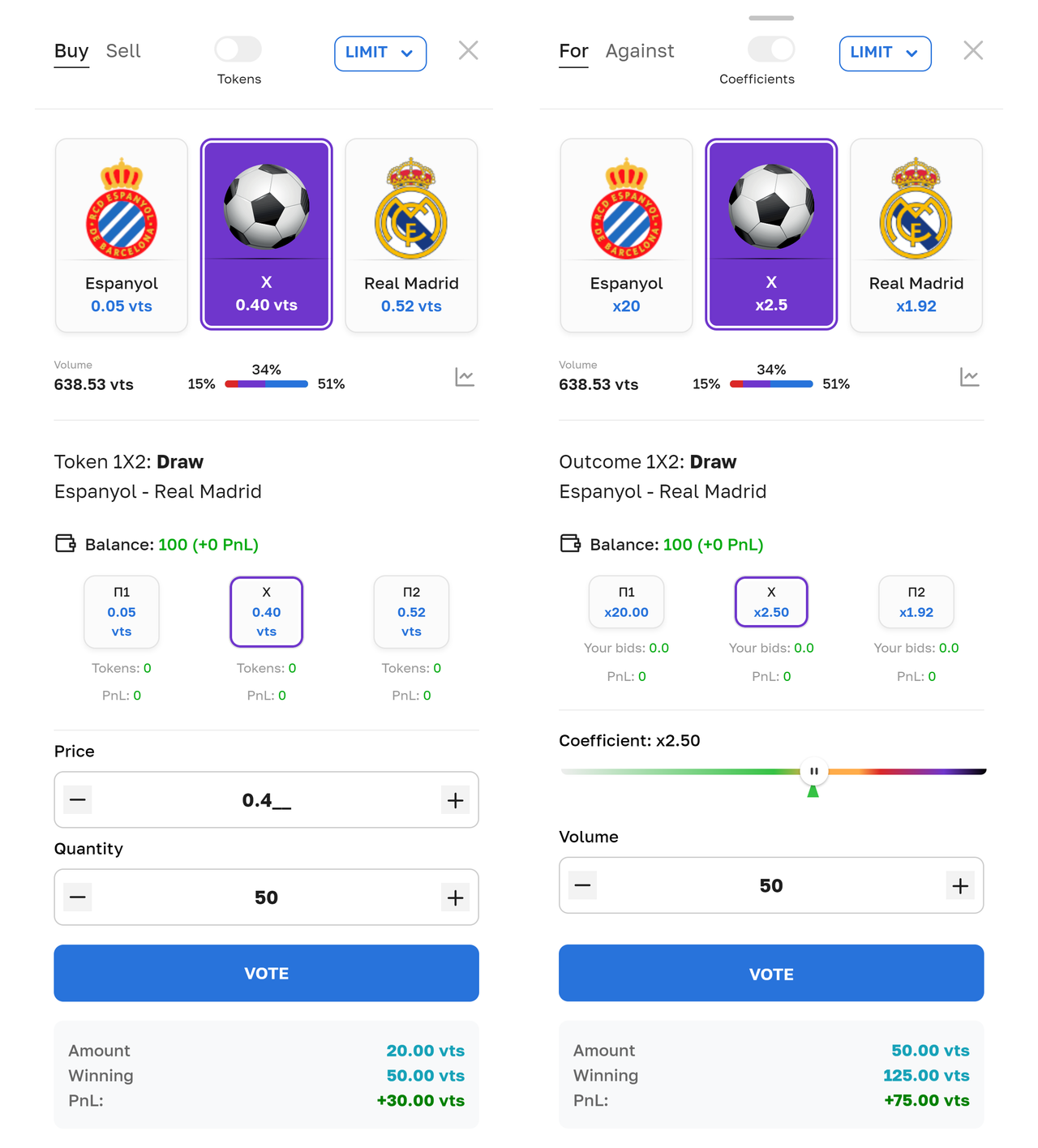
You can create models where any coefficient can correspond to a certain price, and vice versa. So price and coefficient can be one entity. Let's remember this important conclusion.

“Any event from the world of sports, politics, culture, economics, and so on can be tokenized, that is, it is presented in the form of outcomes for events with different probabilities expressed in coefficients/prices”
For example, how to tokenize the event "Will bitcoin reach the 100,000 mark by the end of 2024?". The "yes" or "no" outcomes are synthetic tokens that can reflect market sentiment by trading among themselves as exchange-traded assets. It's the same with sporting events, where every outcome is tokenized.
An example of the model is the VoteSport terminal:
A trader? A betterer? Wouter!
Why bother at all? What does the model that combines the price and the coefficient into one whole give? This makes it possible for both traders and bettors to interact with the platform. Traders who are used to trading the price of assets on various exchanges will be able to make deals with those who are used to betting on odds on outcomes in Bookmakers, and vice versa. And not only in sports, finance, but also in politics, economics, culture, science - in any prediction markets. At the same time, this model makes it possible to take advantage of the synergistic effects of such a merger, which are provided, for example, by both exchange and blockchain technologies.
Now traders will be able to bet on sports, and betters will be able to trade the price of assets, and all this in their usual interface!
What is VoteSport?
“VoteSport is a decentralized P2P betting exchange”
If you immediately understand what I'm talking about, then you probably understand the difference between a regular Bookmaker and a sports betting exchange. The main difference is the approach to the formation of coefficients for the outcomes of events.
How does the Bookmaker form the odds on sports betting outcomes?
The bookmaker puts his betting margin, usually 7-15%, into the coefficient itself, which he offers to the Players. Let's look at an illustrative example right away:
If 2 Players placed the same $100 bets on the victory of the opposing teams in the Champions League final, they will form a pot of $ 200, which will be taken by one of the Players with a coefficient equal to 2x to the original bet. But this is in an ideal world. In the real world, there are Bookmakers who will give odds of 1.7-1.9, not 2.
Let's say that in our example this is a coefficient of 1.8, that is, the pot in the game will be equal to 180 $. Where's the other $20? The Bookmaker immediately took them as his reward. So, the Bookmaker gives a coefficient lower than the real one, already taking into account his margin. Many people are unhappy with this fact. Some people are even outraged by the fact that they can lose in principle.
Bookmakers charge money from Players for organizing the acceptance of bets, and they can also act as the opposite side in the bet. There are different business styles among Betting companies. There are also those who openly cheat, but these are scoundrels and we are not talking about them. No professional Bookmaker would ruin his reputation. But the established model of interaction, when the Bookmaker plays against the Player, remains unchanged.
To give a fixed coefficient for different outcomes, at different times, the Bookmaker measures many parameters: the volume of bets, the probability of outcomes, risk/margin, and puts everything into the coefficient for each outcome. On average, as mentioned above, it can range from 7 to 15%. Whether this is a lot or a little is beyond the scope of this article. Let's just note that any business, especially one as technologically advanced as sports betting, involves high infrastructure and operating costs, after which there should also be a profit. Against this background, the commission of 7-15% in the form of a Betting margin for betting does not look too exorbitant, especially since for many Players sports betting is a one-time entertainment. However, when it comes to more or less experienced or professional bettors (to whom we sincerely wish to become Managers), small commissions play a crucial role for them.
Bookmakers (as well as Exchanges for large traders) offer improved conditions to large players. All Players, without exception, have improved conditions on VoteSport.
Why?
The coefficient/Price for the outcome of events is determined by the Promoters themselves during voting, and the commission is taken from the WINNINGS and currently amounts to 1% for PARI transactions and 0.3% for LIVE transactions.
Thus, even a 5% difference in fees gives a 100% refund after 20 bids. It's simple: "Saved, earned." But this is far from the main thing. The exchange model of the platform is more progressive, has a wide range of tools and more flexible configuration.
It is worth noting that the exchange's business model is transactional, not marginal, as in Bookmakers.
It is also important that VoteSport is a decentralized betting Exchange, that is, built on a blockchain, and this guarantees transparency of operations and a number of technological advantages.
Since VoteSport is an Exchange, what can you trade there? Sports, and not only sports outcomes. In different ways, but always exclusively on the principle of Player versus Player and in no other way, which corresponds to the spirit and concept of VoteSport.
“The exchange's business model is transactional, not marginal, as in Bookmakers”
What are PARI and LIFE?
At the time of writing this article, there is an airdrop of vts tokens and there are two ways to participate in voting and place bets.
PARI is a fast and simplified way to vote with a so—called floating coefficient. It is not fixed — the algorithm recalculates the coefficient after each bet, as each bet changes the quantitative ratio of outcomes in the pot. The PARI reflects the very real coefficient that expresses the real ratio of forces, which is not reduced by % of the Betting margin. That is why it is not fixed, because the scale will constantly outweigh on one side or the other while weighing continues. As soon as you stop manipulating, the scales will come to an equilibrium state. This equilibrium is the final real coefficient, which will be established at the end of the voting on PARI.
The best real odds for everyone! This is a simple and understandable form of interaction with the platform, and therefore it was taken as a game model for the airdrop of vts tokens.
“PARI is an easy way to vote”

Despite its simplicity, this betting format is not suitable for everyone and has a number of limitations. The most important of which is a floating coefficient that is the same for all. Yes, as mentioned above, at the moment when the PARI voting is over, the final coefficient will be the best possible one — the real coefficient. However, it is difficult to build complex game strategies on such a base. At the airdrop stage, such a simplified system is optimal, but in the future, for more experienced Players, the system of static coefficients will be more familiar and understandable, which allows you to calculate the financial result of operations in advance.
From now on, the LIVE market is fully available to Players! The functionality of trading with a fixed coefficient. How does it work?
Now you can offer yourself a coefficient for any outcome and it will be static.
Coefficient trading is a key functionality of the platform, which makes it possible to place bets on fixed terms.
The main advantages of the new voting mechanics in the current implementation are listed below:
- fixed odds
- voting/ betting takes place both BEFORE and DURING the event
- projected profitability
- the ability to buy/sell a bet / vote, earning on the difference, not just on the odds
- deferred bets (limit orders, market orders)
Our V-Trade transaction algorithm (order matching machine) allows you to maximize the use of liquidity. All bets and orders are combined into a single pool without a "liquidity gap" for individual events — this increases capital turnover and gives more dynamics to the voting process itself. All this opens up new possibilities in comparison with classic betting.
“LIVE — suitable for experienced players”
The ability to make bets and trade deals directly with other Players introduces new game dynamics, gives a new user experience, increases the chances of winning and the possibility of additional earnings, which can far exceed the profitability of the bet itself.
So what exactly is VoteSport? A fan vote for your favorite athlete, team, or professional tool? Answer: both. But above all, VoteSport is a community of people who want to build a new gaming ecosystem based on blockchain technologies.
Why do I need a vts token?
What does the term 'token' mean? A token is a digital asset that represents some form of value and is issued on a blockchain."
It is worth mentioning that tokens are not full-fledged cryptocurrencies, as they do not have their own blockchain but operate on the basis of others. The list of the most popular blockchains can be found here. https://coinmarketcap.com/ru/chain-ranking/
The vts token is a token in the Arbitrum One network ( a second-level solution of the Ethereum network) . The Arbitrum One network was chosen based on the combination of characteristics that are most suitable for such a project.
“The VoteSport token has the ticker vts and is deployed on the Arbitrum One network”
Tokens come in different types and purposes, have their own programmable parameters and a wide range of uses. All this functionality is widely used in smart contracts.
How are tokens and smart contracts related?
A smart contract is a decentralized protocol (algorithm) deployed on the blockchain network that initiates certain actions, conducts transactions, monitors the execution of rules, and implements various logic using mathematical algorithms.
“A smart contract is a decentralized protocol based on mathematical algorithms”
The user's interaction with the smart contract takes place through a transaction - sending a token from one address to another. For example, the amount of vts is sent from the Player's address to the address of the VoteSport smart contract in order to vote for a particular sports outcome. This transaction with the information embedded in it triggers certain executable logic on the VoteSport smart contract, which in turn activates certain functions.
Why is tokenization of the project necessary?
The token provides utility, flexible configuration of functionality, and the ability to solve complex tasks in a non-standard way. All this opens up the widest possibilities for building various algorithmic systems, creating new solutions and entities. With the help of the token, you can get a share in the project, access to products and services, rewards for activity, and much more. This is the meaning of the fact that voting is conducted through the vts token, which is simultaneously involved in other programmable protocols that collectively reflect the tokenomics of the project (the project's economy is tied to the token).
Ok. And what does a decentralized p2p exchange mean?
This is the same exchange as a centralized one, but all operations do not take place on the exchange's servers, but on the blockchain network, which guarantees transparency and decentralization.
Decentralization is a conditional thing. There is always some kind of operator, some kind of agent or party, a node or, for example, a miner in the bitcoin network, who has the most influence on the network, on decisions, and so on.
It all depends on the blockchain protocol itself and how many nodes are on the network. The more nodes there are, the more decentralization there is.
Decentralization is a fundamental and very broad concept that can describe both decentralized and distributed systems.
Decentralization is needed not only for, for example, reliable data storage with protection from compromise, and the Blockchain is not just a distributed (but also slow and expensive) database protected by cryptography protocols and node consensus.
However, in the context of the given discourse of the article, for now we will only say that Blockchain is a technology that has given impetus to the decentralization of various services.
“Blockchain is a technology that has given impetus to the decentralization of various services”
Tokenization is a tool for decentralization.
What has decentralization done, for example, in stock trading? The possibility of creating ecosystems like UNISWAP, where, in particular, large market makers no longer have an advantage over ordinary traders who do not have access to the infrastructure of high-frequency trading (HFT-trading). But mainly this system, which has created a lot of incentives within itself, which arose due to the P2P interaction of users through a smart contract without a central owner. And now everyone can become a liquidity provider and receive their own% of income from exchange transactions. Market mechanisms, new phenomena and entities have emerged, such as arbitrage, flash loans, various staking and farming models, and even derivatives. Thus, the decentralization of centralized services frees up the resources of the central owner and distributes them among the network participants, each of whom performs his role and contributes to the maintenance of the decentralized infrastructure.
The decentralization of centralized services frees up the resources of the central owner and distributes them among the network participants”
In exactly the same way, you can transform the usual Betting business into something fundamentally different. But even if absolute decentralization in its true and actual sense is a difficult thing to achieve, partial decentralization, in the context of the main issue of this article — the implementation of new technical approaches to solve specific problems — is already an affordable technology with an acceptable "entry threshold." But, as is often the case, decentralization has brought not only technical opportunities, but also a number of new challenges. But this is a topic for a separate article.
“Tokenization is a tool of decentralization”
What is Tokenomics?
Tokenomics of a project is a concept that describes the economic model of a token, that is, the factors that affect the use and price of a token, its creation, issue, distribution, demand, supply, incentive mechanisms, and many other factors.
Tokenomics is the key to the success of most crypto projects that develop tokenomics rules for their tokens in order to encourage or restrict certain user actions.
“Tokenomics — the economic model of a cryptoproject token”

Tokenomics rules are fixed in the project code and are transparent, predictable and difficult to change.
Why do I need airdrop tokens and why are they burned?
In order to emulate conditions close to real combat conditions at the development stages, complex technical projects like VoteSport conduct various types of testing of their hypotheses, services, models and calculations. All this requires as much statistical data as possible. In order to test all the mechanics of system interaction on real votes of real Players, not only a certain scale is needed, but also the duration of testing, which determines the rules of the airdrop and forecast contest, motivating Players to take active actions.
Therefore, airdrop is the optimal strategy for introducing users to new options and service interfaces in a playful and rewarding manner. At the same time, it is possible to conduct testing in real combat conditions, collect statistics and feedback, fix bugs and make necessary changes before launching the final version of the project in Production.
“Token airdrop is a marketing strategy, a mechanism for promoting cryptocurrency startups”

What's next and what are your plans?
It all depends on the pace of development of the platform and the external conditions. It's not easy to do something kind, reasonable, and bright in such a complex market as Betting. For a long time, a lot of negativity has been attached to this area, which has led to the fact that now all participants do not have the best social coloring. The situation where Bookmakers cheat the Players, and the Bookmaker's Players, is firmly ingrained in the minds of many. The atmosphere of distrust and unscrupulous practices continued to strengthen this status quo for a long time. So the task itself of changing the rules and conditions of the game is an ambitious and time—consuming task. At the level of a paradigm shift. And even impossible, until market participants themselves discover the desire for these changes.
The very desire to place bets without a Bookmaker, naturally, appeared a long time ago, but few people understood before how there could be bets without a Bookmaker? There was no technical option for this. The evolution of the Betting business followed the development of digital technologies and included the early stages of accepting bets "offline", then everything migrated to "online" and only in the early 2000s centralized betting exchanges appeared, which provided new technical possibilities for concluding direct p2p bets between Players and determining the coefficient by the Players themselves. In fact, thanks to mathematical algorithms, the issue of decentralized coefficient determination has been resolved.
The next stage in the development of the Betting business, Exchange betting, and the prediction market, as we understand it, is the synthesis of technologies, mainly blockchain technologies, which can significantly expand the horizons of functionality, in particular, through tokenization of the platform, and further decentralization of the Betting business. Among other things, a full-fledged decentralized autonomous organization (DAO) can be built on the basis of these technologies.
And if the possibility of building a successful DAO, which over time will not be absorbed by the contradictions of the participants, was initially an extreme form of optimism, and even utopia, then building a technical base for the implementation of such a concept is a non—trivial and interesting engineering task with great practical potential.
A further development of this idea was the creation of an ecosystem model where the Players themselves would be participants and motivated agents.
So, at the initial stage, the task was to implement this concept Technically. And we succeeded!
It would be a farce to claim that there is a detailed and detailed plan at the moment. There is a long-term goal, there is a general strategy and short-term tactics, and so far, in many ways, everything is situational. A lot depends on the community itself, whether it wants a project in which they themselves will be active participants, where market mechanisms, transparency, technology and new models of monetization of the betting/prediction process will prevail. Whether they will be able and willing to inevitably board into the crypt for this is an open question.
Surely many people wanted to buy bitcoin, but due to the complexity of the process, they did not do so. It is necessary to know the matcha, to understand the basic principles of the operation of blockchain networks, otherwise the cost of error is very high. Unfortunately, people are irrational agents in a logically strict and unforgiving decentralized system, which is partly why the real true mass penetration, the notorious mass adoption of crypts and blockchain technology has not yet happened. While. But the situation is changing, and with the development of such critical technologies as ZK-Proof (zero-knowledge proof), Account Abstraction may begin to change rapidly. We'll wait and see.
In any case, as a technical product and technology for decentralizing the process of making predictions and betting on sports and the Betting business in general, the project and its developments may be in demand by professional market participants.
In any case, as a technical product and technology for decentralizing the process of making predictions and betting on sports and the Betting business in general, the project and its developments may be in demand by professional market participants.
Although, it cannot be ruled out that the true Bet DAO, a thing that seems utopian today, may one day become the main betting model in the future, and bitcoin will become the world's main reserve asset instead of gold. In any case, those who are with us have a very good chance of winning :)
Article: Tokenomics of VoteSport.
Learn more about the platform.
How to connect Metamask.
Competition with cash prizes.